
Union County VINELink Coverage
VINELink is the public access point for New Jersey VINE, a free and confidential notification service. Official state materials say the program covers custody and status changes from New Jersey state and county correctional systems across all 21 counties. That scope includes Union County custody data and NJDOC custody, but the result still belongs to the reporting system and time shown. VINELink does not turn every county, court, and corrections record into one combined history.
Union County’s facility setup makes the listed location especially important. The Union County Jail address in Elizabeth is now an intake and temporary-detention hub. Long-term Union adult detainees are generally housed at Essex County Correctional Facility in Newark under a shared-services agreement. A VINELink location change from Union to Essex can be a transfer, not a release. Likewise, a move into NJDOC custody means the person entered the state-prison system.
Federal prisoners are outside this state VINE coverage. A federal post-custody question belongs in the Bureau of Prisons locator, while federal pretrial custody may involve the U.S. Marshals Service and a contract holding facility. Immigration custody uses ICE’s own locator. Never treat a VINELink no-result as proof that none of those other systems has custody.
Search Union County VINELink Records
Begin with enough identity facts to avoid a false match. Use the exact legal name and known aliases. Add a date of birth, SBI number, or offender identifier when the search offers that field and the information is already lawfully known. Similar names are common, and a name alone should never connect a custody record to a person.
- Open VINELink or its mobile app and select New Jersey.
- Enter the exact name plus any offered birth-date, SBI, or offender identifier.
- Compare the available identifiers before choosing a result. Do not select the first similar name.
- Open the record and read the custody status and facility exactly as displayed.
- Check whether the location is Union intake, Essex adult custody, NJDOC, or another participating custodian.
- If the person is in custody, choose notification registration and select the desired event and channels.
- Save the time and exact wording of any later alert, then confirm the event with the responsible agency.
Multiple matches require restraint. Compare the person’s identifiers and facility, not just the spelling of the name. If no result appears, recheck the state selection, name variants, and identifier. A no-result can follow an entry error, reporting delay, release, transfer, or a record that is no longer useful after the person left custody. The broader named-person custody and records path appears on the Union County released inmates search.
The image below shows the New Jersey selection and search screen at the official VINELink source.
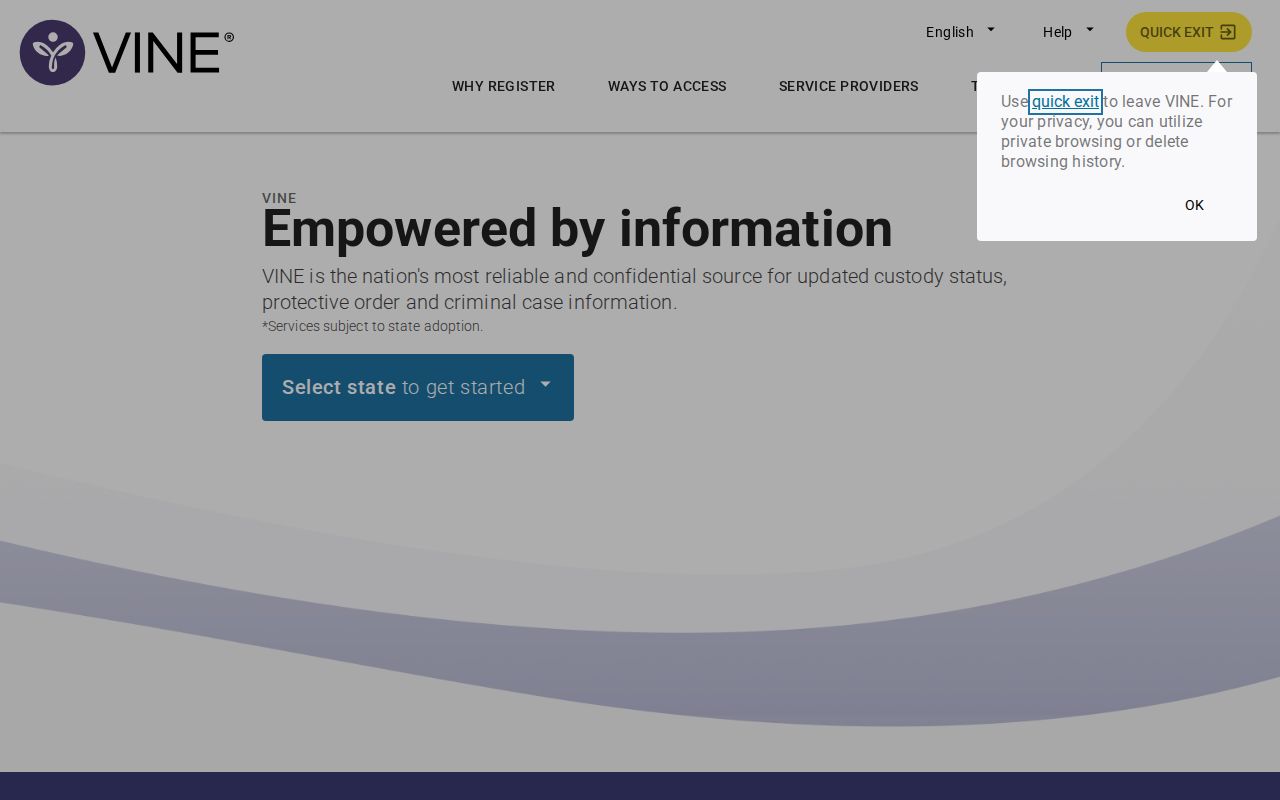
The screen is the starting point, while identity matching and the facility shown determine whether the result relates to the right Union County custody event.
Union VINELink Release Fields
VINELink reports participating custody and status information. It supports a specific-person check and notification enrollment, but official materials do not describe it as a full historical discharge record. Read only the fields actually returned for the selected person. Do not invent a release date or disposition when the screen does not provide one.
| VINELink item | How to read it |
|---|---|
| Name and identifier | Help match the result to the correct person. |
| Custody status | States the participating system’s reported status at that time. |
| Facility or location | Identifies the reporting custodian, which may reveal a transfer. |
| Notification event | Describes the status change VINE reported, such as release or transfer. |
| Alert date and time | Shows when the notice was sent, not necessarily the full agency event record. |
A released person may stop producing a useful result because the current brochure frames VINE around people under custody. An out-of-custody label or no result does not by itself provide an exact release time, release type, destination, or proof of entry into the community. Preserve the alert, then seek the county or state record that owns the event.
NJDOC has different fields for people committed to state prison. Date Out-of-Custody is retrospective. Current Max Release Date and Current Parole Eligibility Date are future-facing calculations and do not show that departure already happened. A county-only detainee who never entered state prison may have no NJDOC record at all.
Register Union County Release Alerts
New Jersey VINE supports phone, text, email, mobile-app, and TTY alerts. Each notification type must be registered separately. Selecting email does not automatically enroll a phone number, and mobile-app enrollment does not replace a text registration. Choose the routes that can be checked reliably and keep the registration details private.
- Open the correctly matched in-custody person’s record.
- Select notification registration and choose the event or custody change offered.
- Enroll phone, text, email, app, or TTY one at a time.
- For a telephone alert, enter a direct number with area code rather than a switchboard.
- Create and save the four-digit PIN used to acknowledge VINE’s call.
- Repeat registration for each additional channel desired.
- When an alert arrives, note its time, wording, and reported facility before calling the agency if confirmation is needed.
The four-digit PIN confirms receipt of a telephone notification. It is not the detained person’s jail PIN and should not be shared. If a call is missed or the message is unclear, contact VINE and the reporting corrections agency. Rumor, forwarded screenshots, and social posts do not replace the source notice.
New Jersey VINE’s official phone access is 1-877-846-3465, and TTY access is 1-866-847-1298. These channels matter for people who cannot depend on web or app access. Registration is free and confidential, but disclosure limits can still affect what the reporting agency supplies.
Confirm Union VINELink Release Alerts
A VINE alert establishes that VINE reported a custody change. It does not always establish community freedom. “Transfer” can mean continued custody at Essex, NJDOC, another county, or another authority. “Release” from one system may also coexist with parole, probation, or a separate hold. Ask the event-owning agency for the release or movement record when the destination matters.
For a Union County adult case, start with the Union lookup disclaimer and then Essex when that facility held the person. The court disposition can show legal authority. If the person went to state prison, use the NJDOC Offender Search and look for Date Out-of-Custody after the departure. If a status says parole, the New Jersey State Parole Board owns the supervision question.
The New Jersey Sex Offender Internet Registry is not a backup jail-release list. It applies only to qualifying publicly disclosed registrants and cannot prove when detention ended. Its fields concern registry status. A person must not be contacted, threatened, or harassed based on registry data. Likewise, the national registry is a registry-specific cross-state tool, not a custody archive.
Keep the conclusion narrow. “VINELink sent a release alert at the stated time” describes the notification. “The Essex record states release to the community” describes the corrections event. “NJDOC lists a Date Out-of-Custody” describes departure from state custody. These statements can support one another, but they are not interchangeable.
New Jersey VINE Alert Network
New Jersey’s statewide layer is distinctive because one service spans participating state and county correctional custody in every county. That breadth helps when a Union County person moves between local intake, Essex custody, and NJDOC. It does not erase the boundaries between those agencies. The facility name and event wording remain central to reading each alert.
The enhanced New Jersey VINE brochure documents the separate channel registrations and the phone PIN. The New Jersey OAG information supplies the state layer around the notification service. Together, those sources support enrollment by phone, text, email, mobile app, or TTY without implying that any one channel is a permanent custody history.
Use more than one alert route when dependable notice matters. Separate enrollment reduces reliance on one inbox, device, or phone line. Then preserve the alert and confirm the event through Union, Essex, NJDOC, or the court. VINE provides the signal. The event-owning agency provides the durable record and the meaning of release versus transfer.
Resolve Union VINELink Conflicts
Conflicts often reflect different clocks and agency scopes. Union can show intake while Essex reports present custody. A court order can authorize release while staff process it. VINELink may report the later status change. NJDOC can then show state custody if the event was transport rather than community release. All sources can be accurate about different stages.
- Release
- Departure from the named custody system, which still requires the destination and supervision check.
- Transfer
- Movement to another custodian, not freedom in the community.
- Parole
- Release from prison to State Parole Board supervision while legal custody continues.
- Probation
- A Judiciary sentence and supervision path that differs from parole.
- Detainer
- A hold lodged by another authority that can prevent or redirect release.
Record the exact status rather than shortening every change to “released.” If the alert and a known court event disagree, compare time, facility, and event language. Direct the final question to the agency that created the movement or release entry. That approach protects accuracy and keeps a Union County VINELink check tied to the right person and custody system.
When calling an agency, ask a narrow question. Request confirmation of the reported movement, the destination, or the records office that owns the event. Do not expect VINE staff to resolve a court order or NJDOC calculation. Each source has a defined role. A clear audit trail of alerts, calls, and agency records makes the final conclusion reproducible without overstating what VINELink itself proved.