
Union County Release Date Fields
New Jersey does not use one all-purpose projected date. The NJDOC field definitions name three distinct fields. Current Max Release Date is the latest calculated end date after recorded days earned and days added for negative institutional conduct. Current Parole Eligibility Date is the State Parole Board’s expected date for parole consideration. Date Out-of-Custody records a completed departure from NJDOC custody.
Those fields answer different questions. Eligibility does not mean approval. A maximum date is not proof that the person will walk out on that day. Date Out-of-Custody looks backward, but it still does not establish whether parole or some other supervision followed. The detailed record, sentence history, court judgment, and agency record must be read together.
| NJDOC field | Meaning | What it cannot prove |
|---|---|---|
| Current Max Release Date | Latest calculated release date after applicable additions and credits | Actual departure on that date |
| Current Parole Eligibility Date | Expected date for parole consideration under SPB policy | Grant, hearing result, or release |
| Date Out-of-Custody | Recorded date the person left NJDOC custody | End of parole or all legal obligations |
Scheduled versus actual: a calculated or eligible date is forward-looking. Only the responsible release record confirms the event that occurred.
Find a Union County Release Date
First decide whether the person is in county, state, or another custody system. Union County’s Elizabeth facility is now an intake and temporary-detention hub. Most adults held beyond intake under the county agreement are housed at Essex County Correctional Facility. A state sentence transfers the record to NJDOC. This local custody map prevents a transfer from being mistaken for release.
- Collect the exact legal name, aliases, date of birth, SBI or booking number, case number, and county of commitment when known.
- For NJDOC custody, open the official Offender Search. Use the SBI number if available, or match name and identifiers carefully.
- Open the detailed record. Compare Current Facility, Initial Admission Date, sentence, county, case, Mandatory Minimum, Current Max Release Date, and Current Parole Eligibility Date.
- For a Union or Essex county sentence, request the judgment, jail-credit calculation, institutional-credit record, warrant or detainer status, and release-event record. Do not apply NJDOC’s field to county-only time.
- For a pretrial detainee, follow the court order and physical custodian. A pending case has no sentence-based max date.
- Near the expected date, verify with the responsible records office. A VINE alert may show a reported change but does not replace the release record.
The Union County release-record search explains how to reconcile Union intake, Essex custody, court disposition, and a targeted OPRA request. If the record names NJDOC or another receiving agency, custody continued. Follow that agency rather than reporting a community release.
Read Union County NJDOC Dates
The official NJDOC field guide defines the release-date labels and their scope:
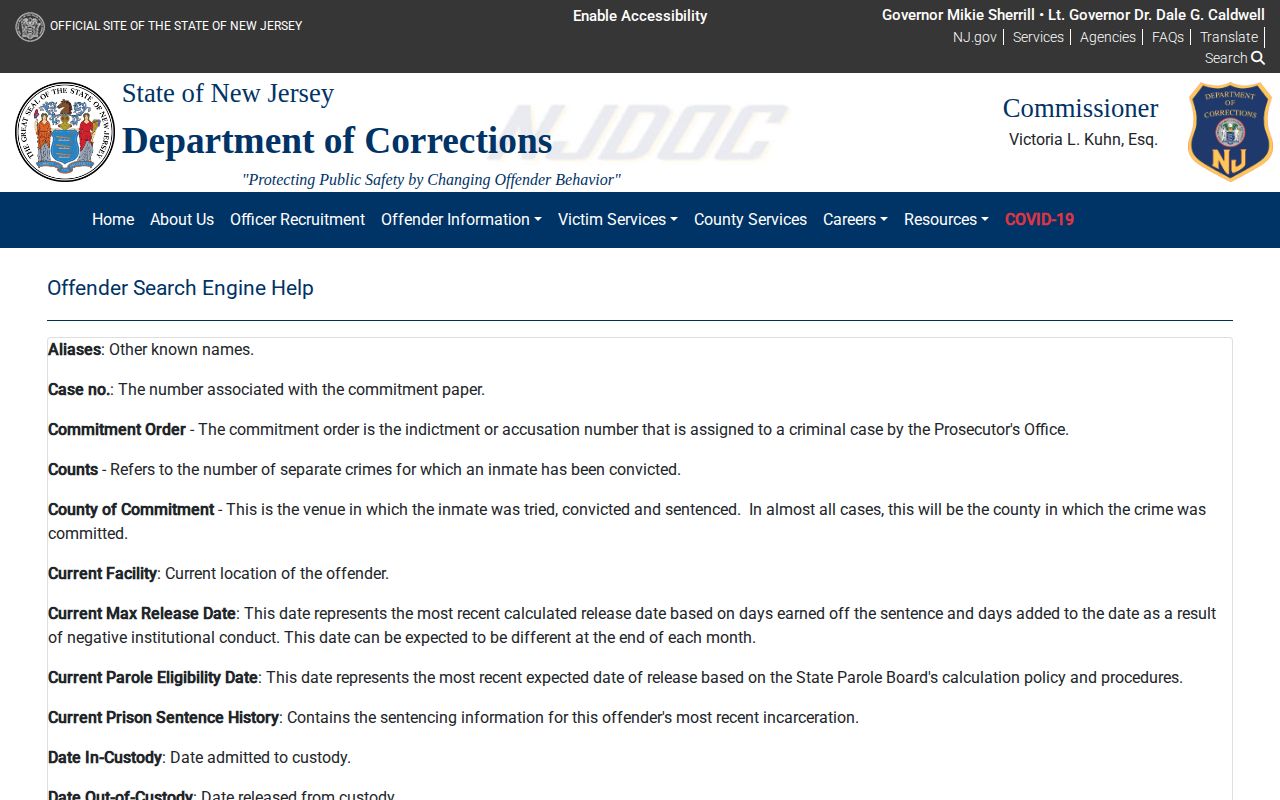
The screen should be read with the individual offender record. Check Current Prison Sentence History and Incarceration History. Match the offense, sentence date, case or commitment order, county of commitment, and mandatory-minimum fields. A similar name is not enough. The SBI number is the strongest public search key when lawfully known.
NJDOC warns that selected information may not reflect a true current location, status, or date. Records displayed for people already released or paroled are not continually updated after departure. For a formal calculation or completed release, use New Jersey’s OPRA route and identify the calculation sheet, incarceration-history record, or final release paperwork being requested.
Note: NJDOC covers state commitments, not a person who left Union or Essex county detention without entering state prison.
Union County Parole Date Rules
Under New Jersey’s parole calculation guidance and N.J.S.A. 30:4-123.51, ordinary eligibility is generally after one-third of the sentence when no judicial or statutory mandatory minimum controls. Credits can reduce the calculation where law permits. They cannot reduce a mandatory floor. Court-awarded jail credits and sentence structure also matter.
Current Parole Eligibility Date marks expected consideration, not release. The Board’s Release Division reviews the case. A two-member panel may grant release, deny it and set a Future Eligibility Term, defer for more information, or refer the matter. A grant can later be rescinded before departure due to new information or an institutional infraction. A scheduled parole date is therefore still subject to the Board’s process and the custody record.
The Earn Your Way Out Act, P.L.2019, c.364, created administrative parole release for eligible people after review and certification. It excludes specified circumstances, including NERA cases and certain sex-offense, sexually violent predator, and Graves Act matters. Administrative parole remains parole. The person stays under the Commissioner’s legal custody and SPB supervision after leaving the facility.
Union County Sentence Credit Rules
New Jersey’s commutation framework is found in R.S.30:4-140 and N.J.A.C. 10A:9-5.1. Commutation means a reduction based on continuous orderly conduct under the applicable schedule. Credits can be forfeited for misconduct under N.J.A.C. 10A:9-5.3. Since the schedule depends on sentence length and structure, a universal days-per-month shortcut would be wrong.
Work credits arise under N.J.S.A. 30:4-92 and its rules. For state-sentenced people housed in adult county facilities, N.J.A.C. 10A:9-5.6 provides one day of work credit for each five days worked beginning with the sixteenth day after sentence. Approved educational or training achievements can support added credit under N.J.S.A. 30:4-92a and applicable rules. These are recorded, conditional credits, not promises of a certain date.
Credit calculations should come from the official record. Ask for the judgment, jail-credit award, current institutional calculation, and any forfeiture or restoration decision. This is especially important for a Union County person whose custody path crossed from county detention into NJDOC.
Union County NERA Release Dates
The No Early Release Act, N.J.S.A. 2C:43-7.2, requires an 85-percent parole-ineligibility term for enumerated first- and second-degree violent crimes. It is incorrect to say all New Jersey inmates must serve 85 percent. NERA applies only to its covered offenses. Institutional credits do not reduce that statutory floor.
NERA also establishes post-release parole supervision. A projected custody date is not the end of that supervision. Confirm the offense, judgment, mandatory-minimum entry, and SPB record before applying the statute. Do not infer NERA from sentence length alone.
Why Union County Dates Change
A date can move for several documented reasons. NJDOC says Current Max Release Date may differ at the end of each month as earned days and negative-conduct additions are posted. Court changes, parole decisions, and outside holds can also alter what happens. No Union-specific weekend-release rule or fixed release hour was verified, so neither should be assumed.
| Factor | Effect on the date or departure | Best confirming source |
|---|---|---|
| Commutation or work credit | May move a calculated date earlier when law and the record allow | NJDOC calculation sheet |
| Institutional misconduct | Can cause forfeiture or add days | Institutional credit and discipline record |
| Mandatory minimum or NERA | Sets a floor that credits cannot reduce | Judgment and sentence record |
| Parole decision | May grant a future date, deny, defer, or rescind | SPB final decision |
| New court order | Can amend credits, sentence, or legal authority | Correct court case |
| Warrant or detainer | Can prevent community departure or cause transfer | Holding and receiving agencies |
Union County Jail Release Dates
A county sentence needs county and court records. Request the judgment, jail-credit calculation, institutional-credit record, warrant and detainer status, and release-event record from the agency that maintains each item. Union may hold intake and classification records. Essex may hold the physical movement or release record for a person housed there. The court holds the judgment and later orders.
Pretrial custody works differently. No completed sentence exists from which to compute a max date. A court may order release, but staff must process the order and check other holds. A person can also move from Union intake to Essex, NJDOC, or another agency. That movement is a transfer, not release to the community.
A targeted county request should ask for the effective release date and time, disposition code and definition, and named destination or receiving agency. It should also identify the judgment, admission record, and date range. If Essex performed the physical release, Union may not hold Essex’s final movement log. Send each request to the agency that created or maintains the specific record.
Weekends and court changes can affect processing, but no published Union County weekend-release rule, fixed release hour, or automatic early-departure policy was verified. Avoid predicting a door-out time from a calendar alone. Staff must resolve the current court order, credits, warrants, detainers, and receiving-agency instructions before departure.
County-date rule: never place NJDOC’s Current Max Release Date onto a county-only case. Use the sentence, credits, court action, and county release event.
Confirm Union County Actual Release
Close to a calculated date, verify with the agency that holds the person. The responsible office can check whether a warrant, detainer, transfer, new court order, or processing step changes departure. For NJDOC, the eventual Date Out-of-Custody is the retrospective field. For Union or Essex, obtain the release or movement record with the effective date, time, disposition, and destination.
A pending custody alert can add notice. The Union County VINELink release check covers participating New Jersey state and county systems. Register while the person remains in custody. Preserve the alert’s time and wording, then ask whether the event was release or transfer. A no-result does not supply an exact release date.
NJDOC release services can provide the departing person with final discharge paperwork and a temporary release photo ID. Depending on the circumstances, the packet can also include a current-charges copy, final trust statement, medical summary, warrant or detainer notice, transportation ticket, referrals, or medication. A person checking their own date should preserve those papers. They can resolve a conflict with a stale public locator.
When sources disagree, compare when each was updated and what system it covers. A court order supplies legal authority, while the jail or prison record supplies the processed movement. Current Max Release Date may change after credits or discipline. Current Parole Eligibility Date may lead to a denial or later grant. An Essex movement can be a transfer to NJDOC rather than freedom in the community.
For a formal NJDOC answer, request an identifiable existing document. Useful choices include the calculation sheet supporting the current max date, the incarceration-history segment, or final release paperwork. Supply the correct name, SBI number, and date range. For Union or Essex, ask for the release-event or movement record and the code definition. This produces a traceable answer without asking an agency to calculate a new date.
Note: Record the field name exactly because eligibility, scheduled release, max date, and completed departure are not interchangeable.