
Union County Parole or Probation
Parole usually follows a New Jersey state-prison term. The New Jersey State Parole Board, or SPB, administers it. A person on parole has left the prison facility but remains under legal custody and community supervision. Probation is different. A New Jersey court imposes probation as part of a sentence, and the Judiciary administers it. Someone can leave Union or Essex county detention directly to probation without ever entering the New Jersey Department of Corrections system.
The source must match the status. An NJDOC record can lead to a parole inquiry, but it cannot establish county-only probation. A sentencing judgment may show probation, but it does not establish the terms of a later parole release. No comprehensive public, name-based roster of New Jersey parolees or Union County probationers was identified in the official source sweep. Verification therefore depends on the applicable agency record and any access limits.
| Point | Parole | Probation |
|---|---|---|
| Who imposes it | State Parole Board release process | Sentencing court |
| Who supervises | New Jersey State Parole Board | New Jersey Judiciary |
| Union County office | District Parole Office 5 in Newark | Union County Probation Division in Elizabeth |
| Best first record | NJDOC history plus SPB record | Judgment and probation case record |
| Custody meaning | Out of prison, still under SPB legal custody | Court supervision, not prison parole |
- Discharge
- The formal end of a supervision term, not merely the end of physical custody.
- Absconder
- A supervised person alleged to have stopped reporting or left supervision without authorization.
- Revocation
- An agency or court action that ends community supervision and can return a person to custody.
- Detainer
- A request by another authority to hold a person or notify that authority before release.
Check Union County Supervision Records
Start with the custody path, not a guess. A Union County adult may have passed through the Sheriff’s intake hub and been held at Essex County Correctional Facility. A state sentence then moves the record into NJDOC. A direct court sentence to probation stays with the Judiciary. The full Union County release search and record path is described on the Union County released inmates home page.
- Confirm the person’s exact name, date of birth, SBI number if known, case number, and the court or county of commitment.
- For a possible state-prison release, use the NJDOC Offender Search. Read Date Out-of-Custody and incarceration history. A historic “paroled” entry does not prove current supervision.
- For parole, contact the State Parole Board public-information channel or submit the Board’s focused OPRA form. Ask for the identifiable supervision or discharge record.
- For probation, read the sentencing judgment and contact Union County Probation Division through the Judiciary. Do not ask NJDOC or SPB to prove probation.
- When records conflict, compare the date, agency, and precise status. Seek the final decision, discharge, revocation, or court order from the agency that owns it.
The SPB record request should be narrow. A requester can identify the person and ask for a final decision or certification, parole release date, Future Eligibility Term, rescission, revocation disposition, or discharge record. Some material can remain confidential. The office may confirm only what law and policy permit.
Note: A person’s absence from an NJDOC facility is evidence of neither active parole nor completed supervision.
Union County Parole Eligibility Notices
The State Parole Board publishes a current Union County Parole Eligibility Notice and weekly archives. This notice identifies people being considered. It can show a name, state prisoner number, judge, sentence, jail credit, sentence date, aliases, location, offense, indictment number, concurrent-sentence notation, and mandatory-minimum information. It is not an exact hearing calendar. It is not a decision database. Appearance on the notice does not mean that parole was granted or that release occurred.
The captured official Union eligibility notice shows the actual county-organized publication channel:
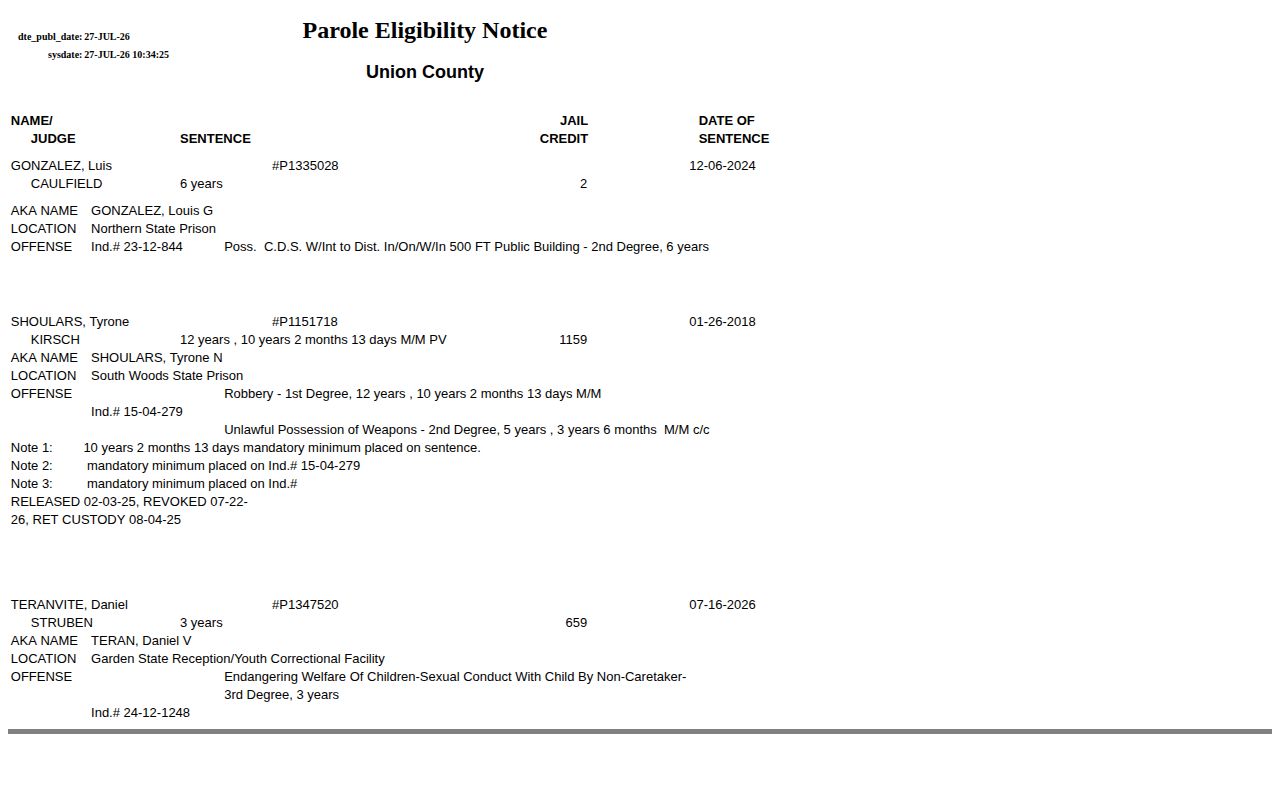
Use its identifiers to check the right person and case, then move to the SPB decision channel. The process may lead to a grant, denial with a Future Eligibility Term, deferral, referral, rescission before departure, or revocation after release. A grant sets a future date and conditions. It is still not the same as NJDOC’s Date Out-of-Custody.
The baseline eligibility rule appears in N.J.S.A. 30:4-123.51. When no judicial or statutory minimum controls, ordinary eligibility is generally based on one-third of the sentence with permitted credits. A mandatory minimum cannot be reduced by institutional credits. The No Early Release Act has a separate 85-percent floor for its listed first- and second-degree violent crimes. That rule does not apply to every New Jersey sentence.
Eligibility also differs from administrative parole under the Earn Your Way Out Act. That law created a review and certification path for eligible people at a primary or later eligibility date, with specified exclusions and conduct, program, and notice criteria. Release under that process is still parole. SPB supervision continues in the community. The final Board record and NJDOC departure record remain the proper proof of what occurred.
Union County Supervision Office Split
Union County parole supervision is assigned outside the county. District Parole Office 5 is in Newark. Probation remains a Judiciary function in Elizabeth. This geographic and agency split is the key local routing fact. Calling the wrong office can produce no useful answer even when a supervision record exists.
District Parole Office 5
124 Halsey Street, 4th Floor
P.O. Box 185
Newark, NJ 07102
Phone: 973-648-3278
Union County Probation Division
1143–45 East Jersey Street
Elizabeth, NJ 07207
Judiciary main number: 908-787-1650
The SPB annual report supplies the parole district assignment. Contact does not guarantee disclosure of protected details. For probation, the sentence and case number help staff route an authorized inquiry. For parole records, the SPB Public Information Office can be reached at SPB-Public-Info-Office@spb.nj.gov; the Board’s central number is 609-292-4257.
Union County Parole Violations
Conditions are the rules attached to community supervision. They vary by order and case. A breach can lead to investigation, a warrant, custody, and a violation process. A parole warrant can place someone in a county jail before transfer into the state revocation process. That jail stay is not automatically a new county sentence. The SPB record should identify the parole action.
New Jersey did not provide a comprehensive public absconder search in the reviewed official sources. Anonymous absconder information can be sent to SPB-Fugitive-Tip-Submit@spb.nj.gov. That address is a tip channel, not a status lookup. VINELink can notify a registered user about participating custody changes, but it does not supply a durable parole history. A release or transfer alert must still be checked against the agency record.
The official SPB hearings description explains rescission and revocation stages. Its captured view helps distinguish a pre-release rescission from a post-release violation:
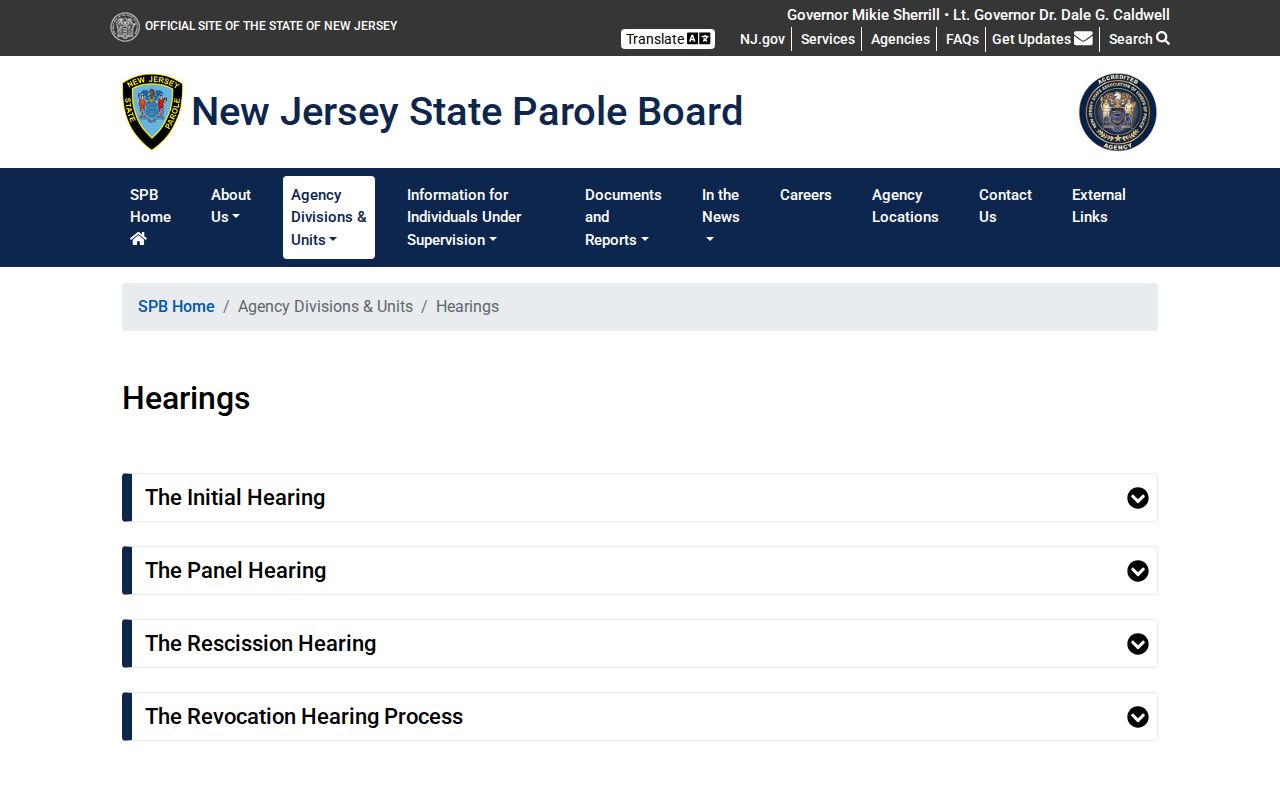
A current warrant or detention can change the custody result. Confirm it with SPB and the facility that physically holds the person.
Union County SLAP Is Different
The Union County Sheriff’s Labor Assistance Program, or SLAP, is a court-ordered alternative to incarceration for screened Municipal or Superior Court participants. They perform supervised public work. The program has operated locally since 1993, but participation is not parole or ordinary probation proof. It is also not evidence that a person completed a jail release event.
Read the sentence and program record in context. A SLAP entry describes a noncustodial sentence pathway. A parole record describes release from prison into SPB supervision. A probation record comes from the court. These sources answer separate questions and should not be merged into one post-release label.
Correct Union County Release Conflicts
Online information can become stale. Union’s own inmate-lookup disclaimer gives a direct correction route: write the Sheriff’s Division of Corrections, Attention Classification Unit, 15 Elizabethtown Plaza, Elizabeth, NJ 07207. State-prison release papers can be stronger evidence. NJDOC says its discharge process can provide a temporary release photo ID, final discharge paperwork, a copy of current charges, a final trust statement, and a medical summary, with other documents or referrals when applicable.
Preserve those first-person records. They may show the actual custody departure more clearly than a web result that is no longer updated. Still, discharge from prison does not always end parole. The SPB supervision or discharge record answers that later question. For county probation, use the court’s final order.
Note: “Released,” “paroled,” and “discharged from supervision” mark different events and should be reported with their source dates.
Union County Supervision Discharge
Supervision ends through formal agency or court action. For parole, request the SPB discharge or final disposition. For probation, seek the Judiciary order or case entry that closes the term. An old NJDOC “paroled” status cannot establish whether supervision ended later because NJDOC warns that released and paroled records are not kept current after departure.
Keep a short verification log. Record the identifiers searched, source, access date, wording shown, office contacted, and final document received. This helps separate prison release, the start of supervision, a violation return, and final discharge. Each is a distinct event in a Union County post-release history.
A court disposition can explain the term but may not show a later agency event. The same is true in reverse. An SPB discharge record concerns parole and does not close a separate probation case. If the person had more than one case, check each judgment and supervising authority. A warrant in another matter can also affect custody after one supervision term ends.
Use exact language in the final note. “NJDOC records a Date Out-of-Custody” confirms a state custody departure. “SPB records parole discharge” confirms the end of that parole term. “The Judiciary case records probation completion” applies to the court term. None should be substituted for the others.